Podcast Equipment: What You Need and What You Don't
The podcast equipment that matters most is a quiet room, one good microphone per person and soft light. Most of what gets sold as essential is optional.
Every week someone shows us a shopping list for their first podcast. Two expensive condenser mics, a mixer with sixteen channels, three cinema cameras, an RGB light for the shelf behind them. Then they record in a room with marble floors and a glass wall, and it sounds like a bathroom.
The podcast equipment that makes the biggest difference is cheap: a room that doesn't echo, one decent microphone per person, and soft light. Get those right and a modest camera setup looks and sounds professional. Get them wrong and no amount of gear saves you.
This guide is for brands in Egypt deciding what to buy, what to rent and what to skip. If you'd rather not buy anything, our video podcast production team brings the full kit to your location or works from a studio.
Here's what this covers:
- Start with the room, not the shopping list
- Microphones: dynamic beats condenser for most rooms
- Recording the audio: interfaces, recorders and backups
- Cameras: how many and which kind
- Light: two soft sources do most of the work
- The small stuff that saves a shoot
- What you can skip
- A realistic budget in Egypt
Start with the room, not the shopping list

Clap once in the room you plan to use. If the sound rings, you have an echo problem, and microphones will capture it.
Most offices and new apartments in Cairo are hard boxes: tiles, glass, bare walls. The fix isn't expensive. Rugs on the floor, heavy curtains, a fabric sofa, bookshelves full of books, a few acoustic panels on the wall facing the speakers. You want soft things around the people talking.
Then listen for noise. AC units, a fridge, the street, a generator in the building. Pick a room away from the street side, and plan to switch off the AC during takes or record early in the day when it's cooler. If you have to choose between a better mic and a quieter room, take the room.
Microphones: dynamic beats condenser for most rooms
Condenser microphones are sensitive. They sound lovely in a treated studio and they pick up everything in an untreated room: the echo, the AC, the car horn three floors down.
Dynamic microphones pick up mainly what's right in front of them. For a podcast in a normal room, that's what you want. The well-known broadcast dynamics are the ones you see on every big podcast. A Shure SM7B, for example, was listed at around 16,000 EGP at Egyptian retailers in late 2025, and that moves with the dollar. There are good dynamic mics for a fraction of that price, and many have both USB and XLR so you can start simple and upgrade your recording setup later.
Give every speaker their own microphone. Sharing one mic between two people always sounds worse, and you lose the ability to fix one voice without touching the other.
For casual shows, walk-and-talk formats or reels, wireless lavalier mics are great. A two-person DJI Mic Mini kit was listed around 5,000 EGP at an Egyptian retailer in 2026. They're fast to set up, but they pick up clothing rustle, so clip them carefully.
Recording the audio: interfaces, recorders and backups
If your mics are XLR, you need something to plug them into. An audio interface connects to a laptop. A portable recorder works on its own. Either way, the goal is the same: each microphone on its own track.
Separate tracks are what let an editor clean one voice, fix a cough, or balance a loud guest against a quiet host. One mixed track gives them none of that.
Always record a backup. Record on the interface and on the cameras' internal mics, or run two recorders. Files get corrupted, laptops crash, someone forgets to press record. With a backup, a bad moment costs you ten minutes of syncing instead of the whole episode.
Cameras: how many and which kind
For a two-person show, three angles is comfortable: one on each person and one wide. Two can work if you frame carefully. We go into layouts and syncing in our guide to multi-camera podcast shoots.
You don't need cinema cameras. Mirrorless cameras are the usual choice because they look good in low light and handle long recordings. Recent phones can work for a starter show, especially if most of your content ends up as vertical clips anyway. Whatever you use, check two things: can it record for an hour without stopping or overheating, and can it run on mains power instead of a battery that dies at minute forty?
Set all cameras to the same frame rate. In Egypt, where the power is 50Hz, 25 or 50 frames per second avoids the flicker you sometimes get from lights at other settings.
Light: two soft sources do most of the work
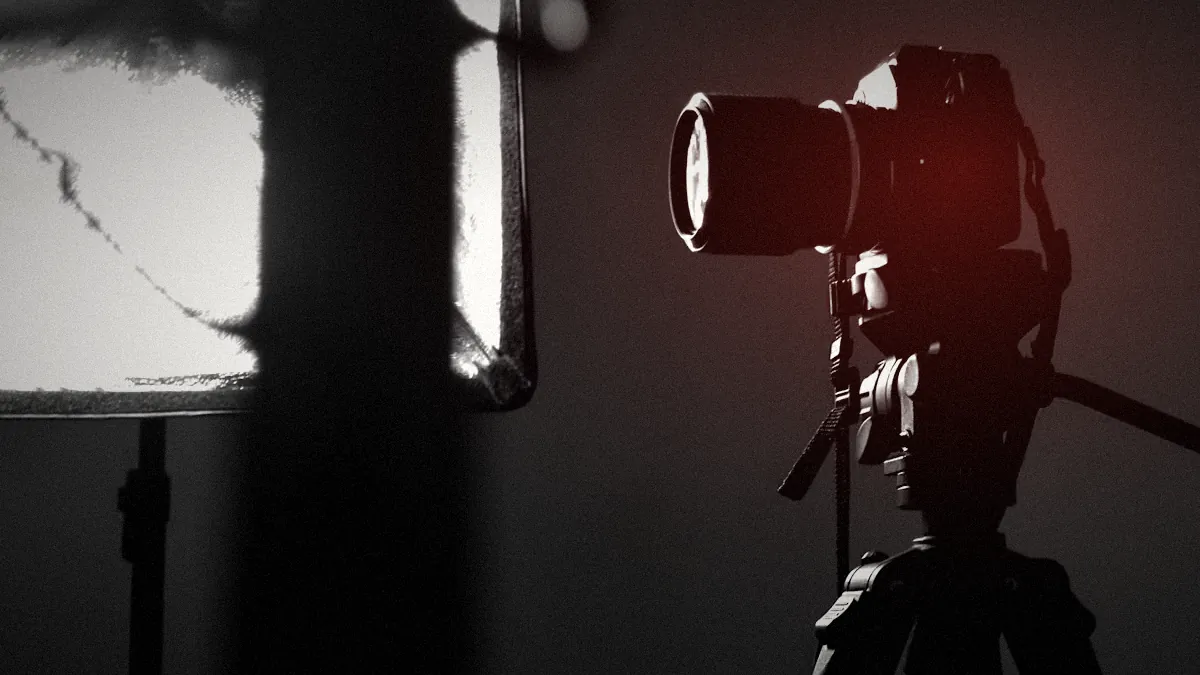
You need one soft light on the faces and something to separate people from the background. That's it for a basic setup.
A soft LED panel with a diffuser or softbox, placed in front and a bit to the side of each speaker, gives flattering light. A small light behind them, or a practical lamp in the background, adds depth so they don't look pasted on a wall. Avoid sitting anyone with a window behind them. The camera will expose for the bright window and the face goes dark.
Keep the light color consistent. Mixing daylight from a window with warm bulbs makes skin look strange and the editor's job harder.
The small stuff that saves a shoot
The cheap items cause the most problems when they're missing:
- Mic arms or stands so speakers don't hold or bump the mics
- Spare cables, and spare batteries for every wireless device
- Enough memory cards, and a laptop or drive to back them up on set
- Headphones for whoever's monitoring the sound
- Gaffer tape, extension leads and a power strip
- Water for the guests, in cups that don't clink on the table
What you can skip
Big mixers with knobs you'll never touch. RGB light shows on the shelves. A fourth and fifth camera before you've made ten episodes. Expensive condenser mics for an untreated room. Pop filters on mics that already have good windscreens. And any gear bought because a famous podcaster uses it, when your room and format are nothing like theirs.
Start with the minimum, record a few episodes, and buy upgrades only when you hear or see a specific problem.
A realistic budget in Egypt
Prices in Egypt follow the dollar, and the same item can vary a lot between shops, so treat any number as a snapshot. The broad picture: a phone-based starter kit with wireless mics, tripods and one or two LED panels stays at the modest end. A proper setup with dynamic mics, an interface, three mirrorless cameras, lenses and lights runs into hundreds of thousands of EGP once everything is in.
That's why we usually tell brands to rent or hire a crew for the first season. You learn what your show needs before you spend on owning it. If you're comparing options, our guide on what to check before booking podcast studios in Egypt helps. And if you want the full kit and crew without buying anything, our podcast production service handles the equipment, the shoot and the edit.
What podcast equipment do I need to start?
A quiet room with soft surfaces, one microphone per speaker, a way to record each voice separately, two or three cameras or phones, and soft lighting.
Which microphone is best for a podcast?
For most untreated rooms, a dynamic microphone works better than a condenser because it picks up less of the room. Wireless lavalier mics are fine for casual and on-the-go shows.
Can I record a podcast with phones?
Yes, for a starter show. Use recent phones on tripods, external microphones and steady lighting. Audio matters more than the camera.
How much does podcast equipment cost in Egypt?
It depends on the setup and on the dollar rate. A phone-based starter kit can stay fairly modest, while a multi-camera setup with good mics and lights runs into hundreds of thousands of EGP.
Do I need acoustic panels for a podcast?
You need something soft in the room: panels, rugs, curtains, a sofa, bookshelves. Bare walls and tiles cause echo that no microphone can fix.
Need this thinking for your brand?
Get a quote